

Strategic Planning with the Product Lifecycle (Industry Lifecycle) Framework
Product Lifecycle (Industry Lifecycle) is a technique that enables better strategic planning in business.
The product lifecycle (also useful in evaluating industries) consists of four stages:
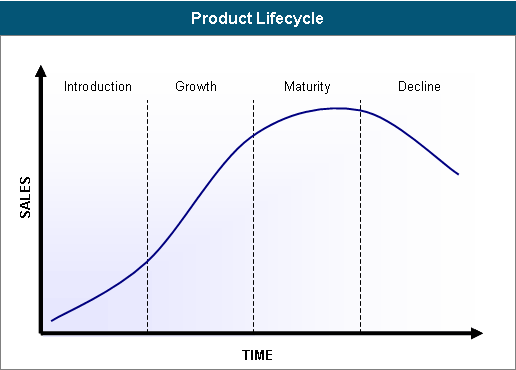 Market introduction stage
- Costs are high
- Slow sales volumes to start
- Little or no competition - competitive manufacturers watch for acceptance/segment growth losses
- Demand has to be created
- Customers have to be prompted to try the product
- Makes no money at this stage
Growth Stage
- Costs reduced due to economies of scale
- Sales volume increases significantly
- Profitability begins to rise
- Public awareness increases
- Competition begins to increase with a few new players in establishing market
- Increased competition leads to price decreases
Mature Stage
- Costs are lowered as a result of production volumes increasing and experience curve effects
- Sales volume peaks and market saturation is reached
- Increase in competitors entering the market
- Prices tend to drop due to the proliferation of competing products
- Brand differentiation and feature diversification is emphasized to maintain or increase market share
- Industrial profits go down
Saturation and Decline Stage
- Costs become counter-optimal
- Sales volume decline or stabilize
- Prices, profitability diminish
- Profit becomes more a challenge of production/distribution efficiency than increased sales
Other Strategic Planning Frameworks
- 4P's Marketing Mix
- Seven S (7S) Management Framework
- AIDA - Attention, Interest, Desire, Action - Buying Process
- Ansoff's Matrix - Product-Market Growth Matrix - Expansion Strategy
- BCG Growth-Share Matrix
- Bass Diffusion Model - Product Adoption and Innovation
- Blue Ocean Strategy
- Choice Model for Decision-Making Behavior
- Competitive Advantage
- Core Competence - Collective Learning in the Organization
- Cost-Benefit Analysis
- Delta Model
- ERG (Existence, Relatedness, Growth) Theory of Motivation
- Experience Curve
- Framing Effect on Psychology and Marketing
- GE (McKinsey) Matrix
- Growth Phases
- Predicting Industry Evolution and Change
- OODA Loop - Observe, Orient, Decide, Act
- PDCA (Plan, Do, Check, Act) - The Deming Cycle
- PEST Analysis - Political, Economical, Social, Technological, Environmental, and Legal Factors
- Perceptual Mapping - Brand Marketing
- Porter's Five Forces
- Product and Marketing Positioning
- Product Lifecycle (Industry Lifecycle)
- Root Cause Analysis
- SWOT Analysis - Strengths, Weaknesses, Opportunties, Threats
- Technology Adoption Curve
- Value Chain
- Balanced Scorecard
- Benchmarking
- Customer Segmentation
- Pricing Strategy & Price Optimization
- Mergers and Acquisitions (M&A)

SATISFACTION GUARANTEE
We have helped thousands of businesses with their research, and we are confident we can help you, too. We offer a 7-Day Money Back Guarantee on all purchases.